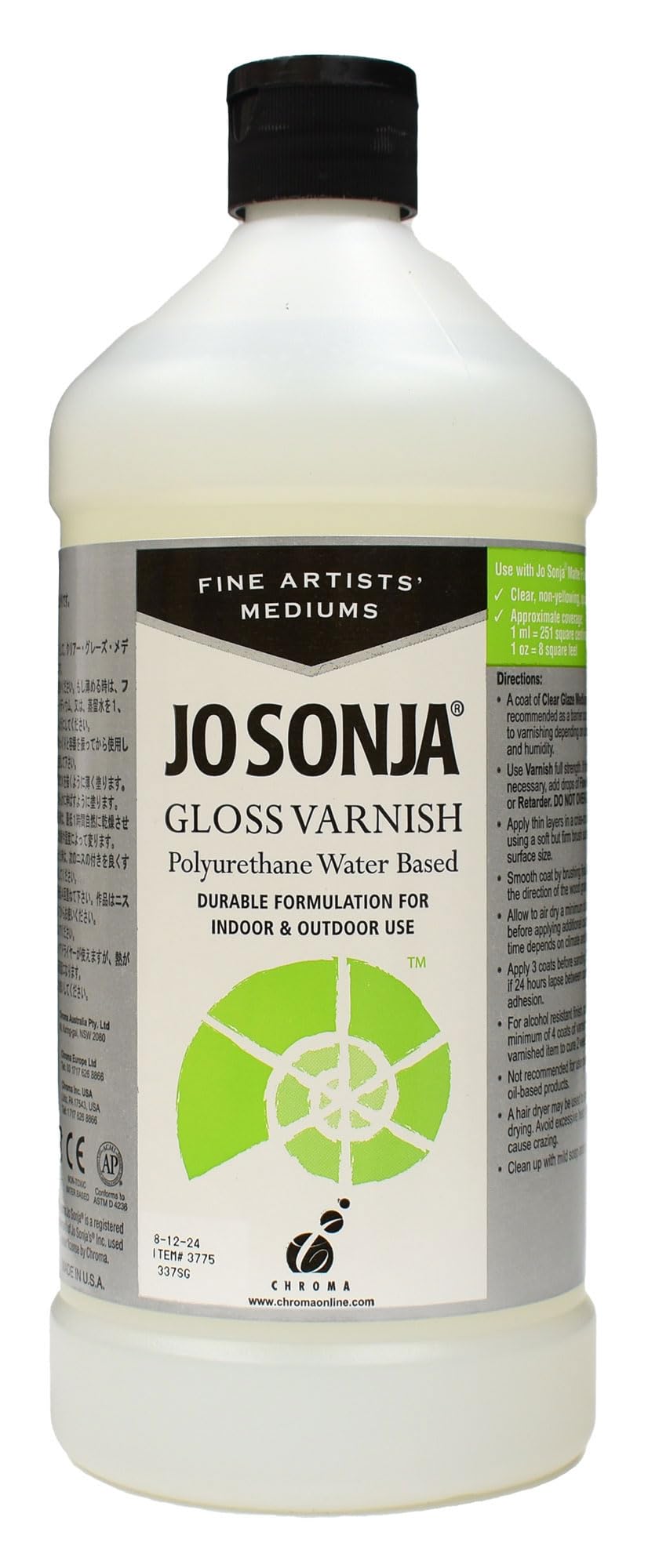
Jo Sonja’s Polyurethane Varnish Gloss is one of those products that sits quietly on the shelf of art supply stores, often overshadowed by more specialized finishes. But for artists who work with acrylics or gouache and need a durable, glossy topcoat, this 32-ounce bottle is worth a second look. It’s not a fancy, art-brand-only varnish — it’s more like a practical, workhorse solution that has been around for decades.
The first thing you notice is the size. A 32-ounce container is a substantial commitment, both in terms of cost and storage space. This isn’t a trial-size bottle; it’s for someone who varnishes regularly, perhaps in a teaching studio or a small production workshop. The gloss level is genuinely high, which can be a bit intimidating if you’re used to satin or matte finishes. On a test panel, it dried to a very reflective, almost glass-like sheen. That’s exactly what you want for certain subjects — think vibrant abstracts, detailed illustrations, or pieces that will be displayed under gallery lighting.
Application is straightforward. It brushes on smoothly, though you need to work relatively quickly because it starts to set. A soft, wide brush works best, and you should avoid over-brushing once it begins to tack up. The varnish self-levels reasonably well, but it’s not magic. If you apply it too thick, you’ll get visible brush strokes or even bubbles. Thin, even coats are the way to go. I found that two thin layers gave a much better result than one heavy coat. The drying time is moderate — you can usually touch it after a few hours, but it’s best to wait a full day before handling the piece or applying another coat.
One of the standout features is its versatility. It’s not just for canvas. It works on wood, paper, and even some sealed ceramics, which makes it handy for mixed-media projects. It also holds up well to minor scratches and fingerprints once fully cured, which is more than can be said for many acrylic varnishes. For pieces that will be shipped or handled frequently, this added toughness is a real advantage.
However, there are trade-offs. This varnish has a noticeable odor and requires good ventilation — it’s not a low-VOC product. If you work in a small, unventilated room, the smell can be overwhelming. Also, because it’s a polyurethane, it has a slight amber tint when applied thickly. On a white canvas, this might be a concern. In practice, thin coats dry clear, but it’s something to test before committing to a final piece. Another limitation is that it’s not removable with turpentine or mineral spirits in the way that traditional damar varnish is. Once it’s on, it’s on. That means you can’t easily “regenerate” the varnish layer if it gets dirty or yellowed over time. For conservation-minded artists, this is a significant drawback.
Compared to dedicated artist varnishes like Golden’s Polymer Varnish or Liquitex Soluvar, Jo Sonja’s is a more budget-friendly option. Those products are designed specifically for fine art, they’re removable, and they offer UV protection. Jo Sonja’s does not advertise UV protection, which is worth noting if you’re selling work that will be displayed in direct sunlight. However, for an artist who wants a tough, glossy finish and doesn’t mind the permanence, it holds its own. In fact, it feels more like a furniture-grade finish than a traditional art varnish, which is both its strength and its weakness.
So who is this for? It’s ideal for acrylic painters who produce a high volume of work and need a reliable, hard-wearing finish without the premium price tag. It’s also great for crafters who make decorative items like painted trays or ornaments that will see daily handling. On the other hand, if you’re a fine artist who values archival quality, works in a small space, or prefers the ability to remove a varnish for cleaning, you might want to look elsewhere. Similarly, if you’re working on paper, you’ll need to be careful — the varnish can cause the paper to buckle unless it’s mounted or the paper is heavy enough.
In practice, this varnish performs as advertised: glossy, durable, and easy to work with if you respect its quirks. It’s not a miracle product, and it won’t make a mediocre painting look like a masterpiece. But for what it is — a practical, no-frills varnish in a generous size — it does the job well. Just remember to work in a ventilated area, apply thin coats, and accept that it’s a permanent decision. If that sounds like your kind of project, this bottle will last you a long time.