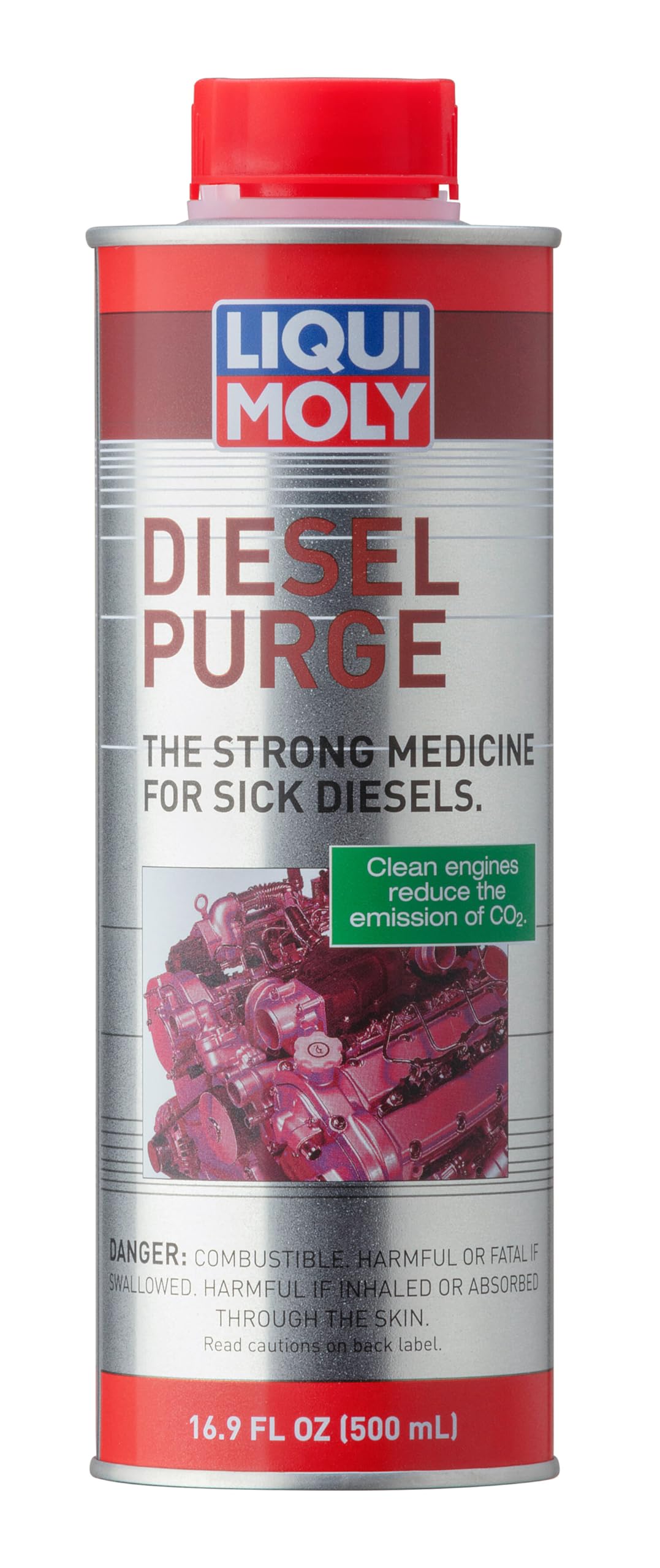
Diesel Purge sits in an odd corner of the additive market. It is not a bottle you tip into the tank at every fill-up, and LIQUI MOLY does not present it that way. The 500 ml can is intended as an occasional, concentrated treatment for diesel fuel systems, and the way it is used matters more than most buyers expect. Understanding that distinction is the difference between a product that does what it claims and one that seems to do nothing.
The most common way to use Diesel Purge is not through the fuel tank at all. Many workshops and experienced owners run the engine directly from the can, feeding the injection pump or low-pressure circuit with neat additive until the can is empty. This is the method LIQUI MOLY describes for heavier cleaning, and it is the reason the product has a following among people maintaining older diesels, farm equipment, and vans with clogged or sluggish fuel systems. A second, simpler method is to add it to a small quantity of diesel in the tank as a one-off shock treatment. The two approaches produce noticeably different results, and the direct-feed method is the more aggressive of the two.
What the product actually is matters here. Diesel Purge is a solvent-heavy blend designed to dissolve varnish, gum, and carbon deposits in injectors, pumps, and fuel lines. It contains no cetane improver and no lubricity additive in the sense that a regular every-tank additive would. That is a deliberate design choice: this is a cleaner, not a fuel conditioner. Buyers who expect it to smooth running, boost cetane, or improve economy on an already-clean engine are likely to be disappointed. Its job is to remove deposits, and once those are gone there is little left for it to do.
Realistic expectations are worth spelling out. On a diesel with genuine injector fouling, owners commonly report smoother idle, reduced hesitation, and less smoke after a direct-feed treatment. On a modern common-rail engine running clean fuel and serviced on schedule, the visible change is often minimal. That is not a failure of the product so much as a mismatch between the product and the engine’s condition. The stronger the existing deposits, the more noticeable the result tends to be.
There are practical limitations. The direct-feed method requires some mechanical confidence, a length of hose, and a willingness to work around the fuel system; it is not a pour-and-go job for most people. Running the engine on neat solvent also means you should not leave the vehicle unattended, and any spilled product needs proper disposal. The 500 ml can is a one-shot size, so there is no measuring or partial use to speak of. Cost per treatment is higher than a bottle of ordinary injector cleaner, and the product is not something you would use routinely. It also does not address mechanical faults: a worn injector or a failing pump will not be fixed by any solvent, and buyers should not expect it to.
Compared with the everyday diesel additives sold in the same aisle, Diesel Purge occupies a different role. A standard injector cleaner or fuel conditioner is formulated for regular, low-dose use and is meant to keep a clean system clean. Diesel Purge is a periodic deep clean, closer in spirit to a workshop flush than to a maintenance additive. If your goal is ongoing lubrication and deposit prevention, a conventional conditioner is the more appropriate purchase. If the goal is to address an existing problem before resorting to pulling injectors, this is the category to look at.
Who is it for? Owners of older or high-mileage diesels, people running equipment that sits for long periods, and anyone dealing with rough running that points to fuel-system deposits are the natural audience. It also suits those comfortable doing light mechanical work, since the most effective method is the direct-feed one. Who is it not for? Drivers of late-model common-rail cars with no symptoms, people who want a set-and-forget fuel additive, and anyone unwilling to follow the direct-feed procedure. For those buyers, a regular conditioner is a better fit and less fuss.
The honest summary is that Diesel Purge is a focused tool rather than a general-purpose additive. It earns its place when there is a real deposit problem to solve and the user is prepared to apply it properly. Treated as a miracle in a can, it will underwhelm; used as a targeted cleaner on a neglected fuel system, it has a reasonable record. The 500 ml format, the solvent-based formulation, and the two application methods all point to the same conclusion: read the instructions, match the product to the engine’s condition, and expect cleaning rather than transformation.