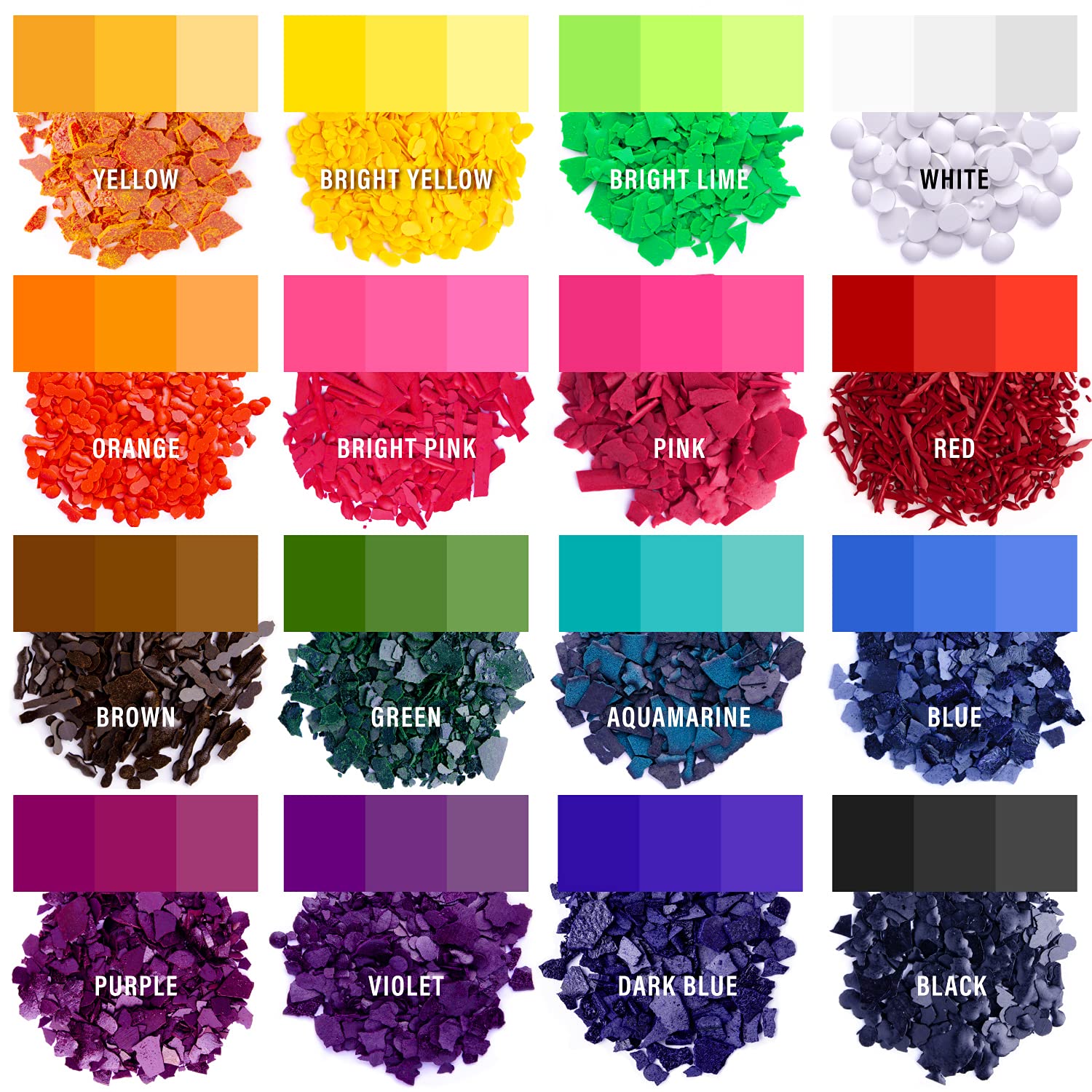
When you’re making soy wax candles at home, getting the color right can be surprisingly tricky. Liquid dyes are messy, and some powders don’t blend evenly, leaving streaks or faded patches. That’s where dye chips like this set of 16 vivid colors come in. They’re designed to be melted directly into the wax, so you don’t need extra solvents or mixing equipment.
I tested these chips with a standard soy wax (464, which is common for container candles) and found that they dissolve completely when the wax is heated to around 185°F. The color distribution was consistent throughout the pour, and I didn’t see any clumps or settling at the bottom of the jar. That’s a clear improvement over some powdered dyes that can leave tiny specks if not stirred aggressively enough.
The set includes a broad range of hues, from deep reds and blues to softer pastels like lavender and mint. Each chip is about the size of a fingernail, and they’re highly concentrated. For a typical 8-ounce candle, using one chip gave a medium saturation; two chips produced a very deep shade. This concentration is both a strength and a trade-off. On one hand, a little goes a long way, so the pack will last through many batches. On the other hand, it’s easy to accidentally overshoot your desired color if you add too many chips at once. I recommend starting with half a chip and testing on a small wax sample before committing to the full melt.
One limitation worth noting: the color payoff varies noticeably depending on the wax type. In a softer soy wax, the colors appear slightly muted compared to what you’d get in paraffin or a soy-paraffin blend. If you’re aiming for bright, neon-like results, these chips may not deliver that punch. They produce more of a rich, satin finish that works well for rustic or natural-looking candles, but they might feel underwhelming for a glossy, high-impact aesthetic.
Compared to liquid candle dyes, these chips are much less messy. There’s no dripping, no staining of countertops, and no need to clean syringes or droppers. They also store easily in a small bag or jar without risk of spilling. However, liquid dyes often offer more control over very subtle tints, because you can add one drop at a time. With chips, you’re limited to roughly quarter-chip increments, which can make fine-tuning a pastel shade more difficult. For someone who regularly makes very pale candles, a liquid dye might be a better fit.
Another practical consideration: the chips do not have a strong smell on their own, which is good if you’re using fragrance oils and don’t want competing scents. But I noticed that in a few of the darker colors (like navy and black), the dye seemed to slightly mute the fragrance throw. This is a known issue with many colorants—dark pigments can sometimes bind with fragrance molecules—so it’s not unique to this product. If you’re making strongly scented candles, you may want to test the final hot throw with a few of the deeper shades before committing to a large batch.
Who is this product for? It’s a solid choice for hobbyists and small-scale candle makers who want a clean, straightforward way to color soy wax without the mess of liquids. The variety of colors in one pack is convenient for experimenting with different palettes. It’s also suitable for someone who prefers a consistent, streak-free result and doesn’t mind a slightly muted finish.
Who might want to look elsewhere? Professional candle makers who need precise, repeatable color matching for commercial production might find the chip format too imprecise. Also, if your primary goal is creating ultra-bright or fluorescent candles, you’d likely be better served by specialty liquid dyes designed for that purpose. Finally, if you work primarily with paraffin wax or wax blends, test a single chip first—the performance may differ from soy.
Overall, these dye chips do what they claim: they add color to soy wax easily and with less mess than many alternatives. The 16-color set offers good variety for the price, but the limitations in subtlety and brightness mean it’s not a one-size-fits-all solution. For the home candlemaker who values convenience and a natural look, it’s a practical option worth considering.