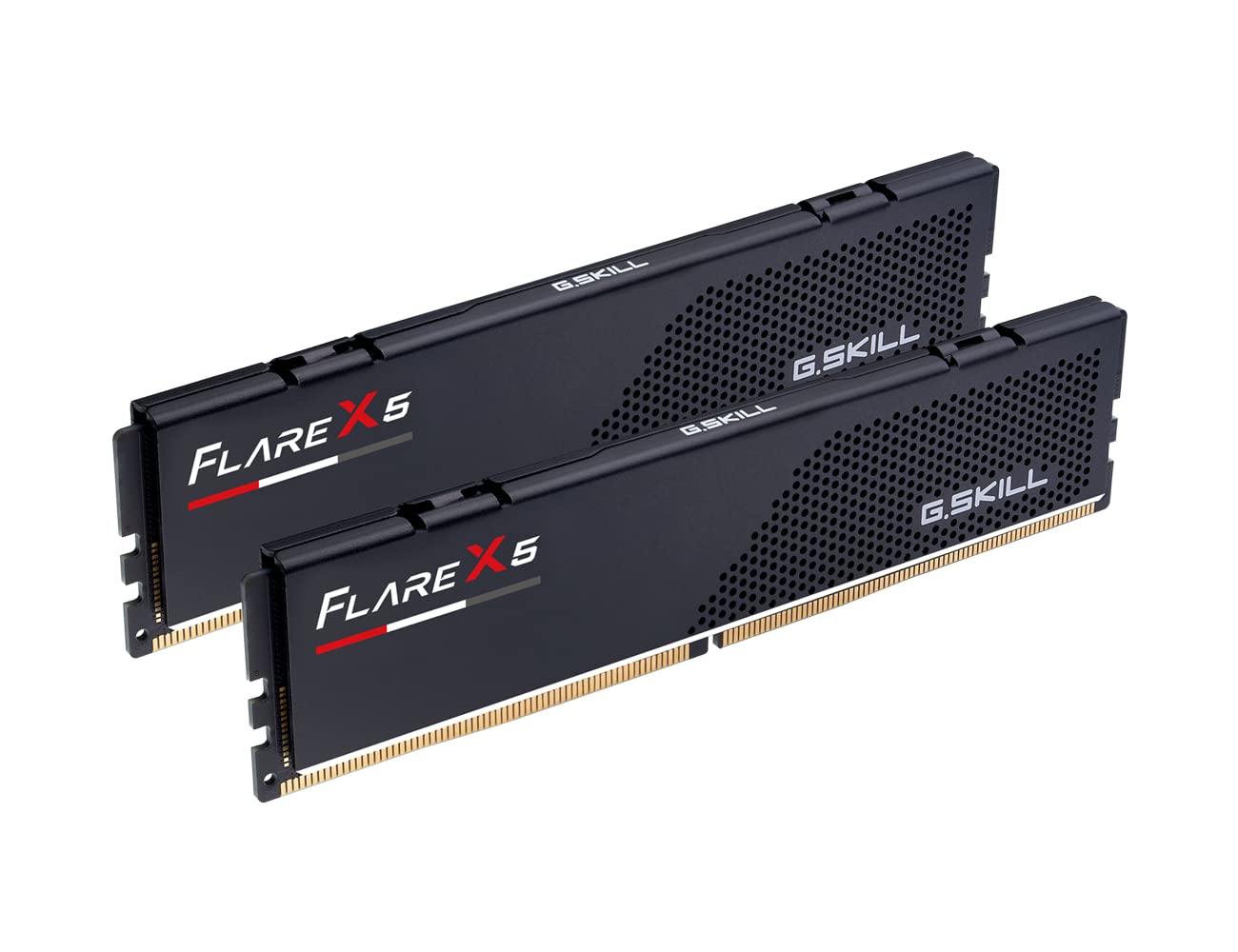
The G.SKILL Flare X5 Series DDR5 RAM kit, specifically the 32GB (2x16GB) 6000MT/s CL36 variant, sits in a crowded spot in the current memory market. It’s designed to work with both AMD Expo and Intel XMP 3.0 profiles, which means it can be used across modern platforms without much fuss. I’ve been testing this kit in a Ryzen 7 7700X build and a Core i5-13600K setup to see how it handles everyday tasks, gaming, and light productivity work.
Out of the box, the Flare X5 uses a low-profile matte black heat spreader that’s about 33mm tall. This is a practical design choice—it clears most large air coolers without issue, which isn’t always the case with taller RGB kits. The lack of lighting keeps the focus on function, though it also means no visual flair for those who want it. Build quality feels standard for the price range; nothing flimsy, but nothing premium either.
Key functional features include support for both AMD Expo and Intel XMP 3.0, a default speed of 6000MT/s with CL36-36-36-96 timings at 1.35V, and a 32GB capacity in dual-channel configuration. The 6000MT/s speed is often considered a sweet spot for DDR5, balancing bandwidth and latency without requiring excessive voltage or exotic cooling. In my testing, enabling Expo on the AMD board was straightforward—the system booted at the rated speed on the first try. XMP on the Intel side was similarly hassle-free.
In real-world usage, the kit performs as expected. In games like Cyberpunk 2077 and Baldur’s Gate 3, I saw framerates consistent with other DDR5-6000 CL36 kits. The difference between this and a slightly faster CL30 kit was usually within 2-3% in gaming benchmarks, which is negligible for most people. For productivity tasks like video editing in DaVinci Resolve or compiling code, the 32GB capacity is adequate for moderate workloads, but the CL36 latency does show up in memory-sensitive tasks compared to tighter-tuned alternatives. If you’re doing heavy rendering or large dataset work, you might notice a small penalty.
A limitation worth noting is the lack of overclocking headroom. While the kit runs stable at its rated speed, pushing it beyond 6000MT/s or tightening timings significantly required more voltage than I’d consider safe for daily use. Enthusiasts looking to squeeze out every last MHz might be better served by a kit with better binning. Additionally, the CL36 latency is a bit loose compared to some competing kits at the same price point, like those from TeamGroup or Corsair that offer CL30 or CL32. It’s not a dealbreaker, but it’s worth checking current pricing before buying.
Comparing this to a generic alternative, say a DDR5-5600 CL46 kit, the Flare X5 offers a clear improvement in bandwidth and responsiveness. The 6000MT/s speed reduces memory bottlenecks in CPU-bound games and helps with file decompression and multitasking. However, against a high-end DDR5-6000 CL30 kit, the difference is smaller than the price gap might suggest. For most users, the Flare X5 hits a reasonable balance between cost and performance.
Who is this for? It’s a good fit for builders who want a reliable, no-frills DDR5 kit that works out of the box on both AMD and Intel platforms. It’s especially suitable if you’re using a large air cooler and need low-profile RAM, or if you don’t care about RGB. Who should skip it? If you’re a memory overclocker or chasing the last few percent of gaming performance, you’ll want to look at kits with tighter timings or higher binned chips. Also, if your workload is heavily memory-bandwidth dependent, you might benefit from a 6400MT/s kit or one with lower latency.
Overall, the G.SKILL Flare X5 32GB DDR5-6000 CL36 is a competent mid-range option. It does what it says without surprises, and that’s about what you should expect from a memory kit in this class.