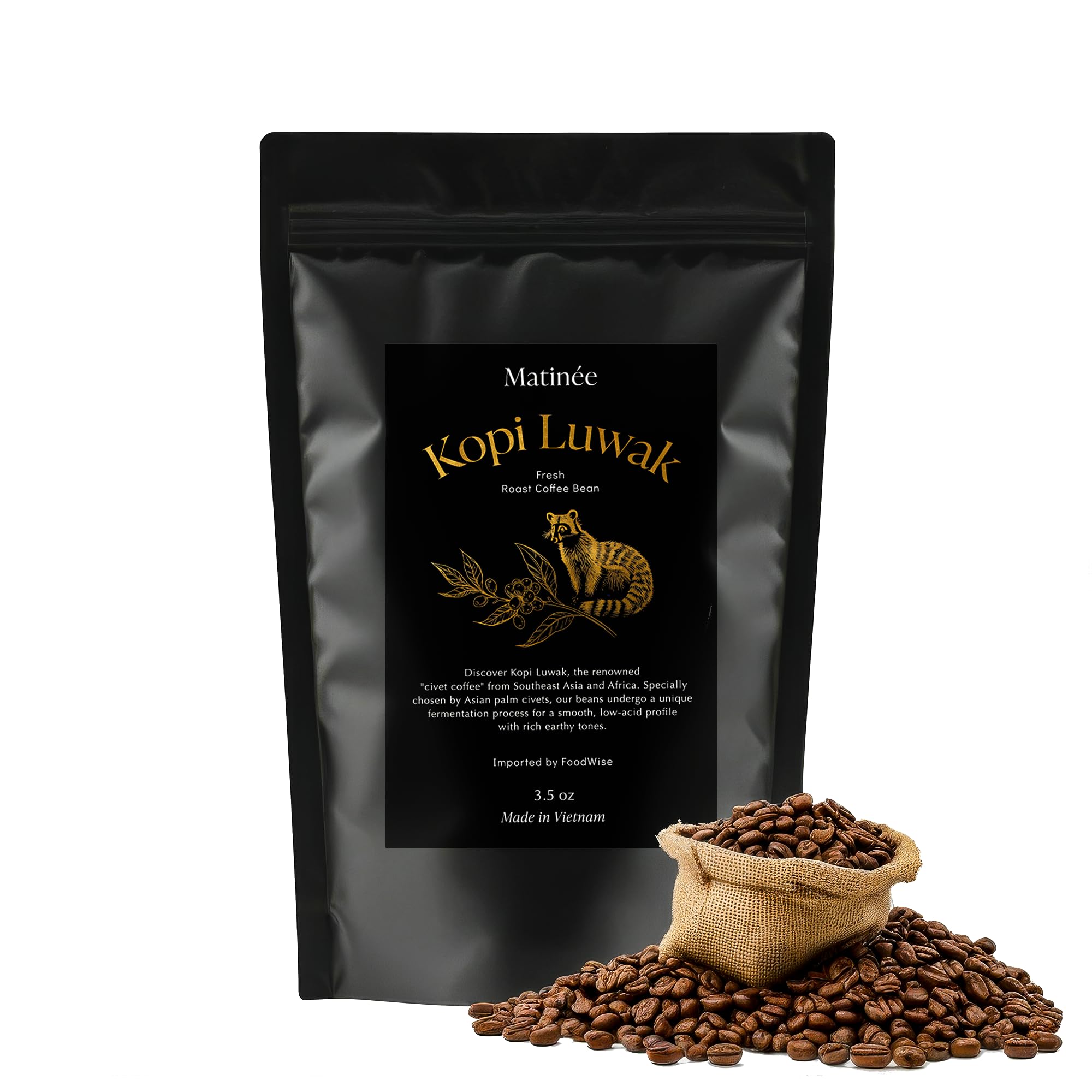
Kopi luwak occupies an odd place in the coffee world. It is among the most talked-about and least understood coffees sold, and the MATINÉE Wild Kopi Luwak offering—100 grams of whole beans, medium roast, produced in Vietnam—is a good example of how the category is packaged for gifting and occasional drinking rather than everyday use. This is a small bag, roughly enough for six to eight brewed cups depending on dose, and it is priced and presented as a novelty-adjacent luxury rather than a staple. That framing matters when judging what it actually delivers.
The first thing worth clarifying is what “wild” is doing on the label. True wild kopi luwak comes from beans collected from the droppings of free-ranging Asian palm civets, which eat coffee cherries selectively and pass the seeds through digestion. The enzymatic process is often credited with reducing bitterness and producing a smoother, earthier cup. In practice, genuinely wild-sourced luwak is scarce and expensive, and much of what is sold as wild is either farmed or blended. Buyers should treat the term as a sourcing claim that is difficult to verify from a retail bag, not a guarantee. MATINÉE states Vietnamese origin, which is plausible—Vietnam is a major robusta producer and has a long history with the luwak trade—but the bag alone does not tell you the civet-to-bean ratio or whether the beans are arabica, robusta, or a blend.
In the cup, medium-roast luwak typically lands somewhere between a conventional smooth coffee and something more unusual. Expect low acidity, a syrupy body, and notes that reviewers often describe as earthy, woody, or faintly chocolatey. It is not a bright, fruity coffee, and anyone coming from a light-roast specialty background may find it muted. The medium roast here is a sensible choice for the category because darker roasting would bury the subtle characteristics that justify the price, while a lighter roast risks exposing defects. Realistic expectation: a soft, rounded, slightly savory cup that is pleasant but not transformative. The gap between luwak and a good washed arabica is smaller than the price difference suggests.
Whole beans are the right format for this product. Pre-ground luwak would lose much of its character quickly, and 100 grams is small enough that staleness is a real concern once opened. A sealed bag with a one-way valve helps, but a hundred-gram quantity means the coffee will be consumed or fade within a few weeks. Store it airtight, away from light, and grind just before brewing. For brewing, the medium roast suits drip, pour-over, and French press; espresso is possible but the small bag makes dialing in wasteful. A modest dose of 12–15 grams per cup is reasonable.
Where this product makes the most sense is as a gift or a tasting curiosity. The 100-gram format, the Vietnamese origin story, and the luwak angle give it conversational value, and it fits occasions where someone wants to try something they would not buy for themselves. As a daily coffee it does not hold up—the cost per cup is many times that of a solid specialty bean, and the flavor profile is too gentle to anchor a morning routine.
- Strengths: whole-bean format preserves freshness better than pre-ground; medium roast is appropriate for the category; small size suits gifting and sampling; low acidity and smooth body appeal to drinkers who dislike sharp coffee.
- Limitations: “wild” sourcing is hard to verify; 100 grams is a short window before staleness; the flavor is subtle and may underwhelm relative to price; ethical concerns about civet farming persist across the category and cannot be resolved from packaging alone.
Compared with other novelty or luxury coffee categories—Jamaican Blue Mountain, Hawaiian Kona, or high-end Geisha lots—kopi luwak is the least consistent in quality and the hardest to authenticate. Blue Mountain and Kona at least have appellation systems; luwak largely does not. A drinker comparing this bag to a well-sourced single-origin at a fraction of the price will likely conclude the premium buys novelty and smoothness rather than complexity.
This is suitable for curious drinkers, gift-givers, and anyone who prefers mellow, low-acid coffee and wants to try luwak once. It is not suitable for value-focused daily drinkers, fans of bright and complex light roasts, or anyone unwilling to accept that the sourcing claims are essentially unverifiable at retail. Buy it as an experience, not a habit, and judge it on whether the cup is pleasant and the story is worth telling—both of which it can reasonably deliver.