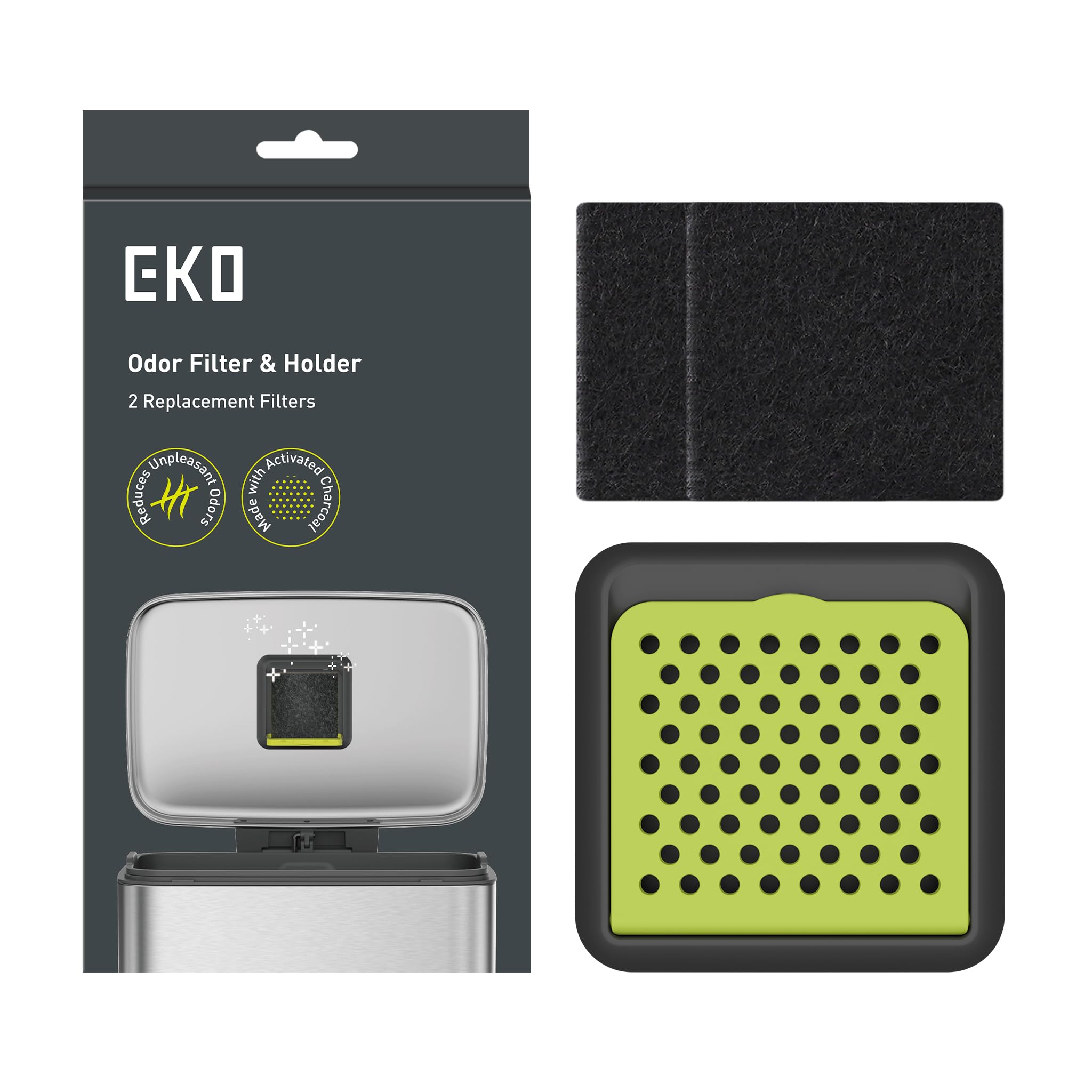
Odor control for kitchen trash cans tends to be one of those problems people solve reluctantly, usually after a bin has already developed a smell that lingers in the corner of the room. The EKO Trash Can Deodorizer Filter Kit with Case, sold as a two-pack, is a small accessory aimed at that specific problem. It is not a standalone appliance or a substitute for regular cleaning, but rather a consumable part designed to work with compatible EKO bins that have a built-in filter compartment. Understanding what it does and does not do is the key to deciding whether it belongs in your kitchen.
The kit consists of two deodorizer filters and a small case that holds them. The filters are intended to be placed inside the lid or filter housing of an EKO trash can, where air passing through the bin is exposed to the filter material. The case serves as a holder and makes swapping filters less messy, which matters because these components tend to collect dust and residue over time. In practice, the installation is straightforward: the filter goes into the case, the case fits into the designated slot, and the bin lid closes as usual. There is no wiring, no batteries, and no setup beyond that.
In real-world use, this kind of filter is best understood as a maintenance item rather than a fix. A kitchen bin that is emptied regularly and wiped down periodically will benefit from a filter that absorbs some of the ambient odor coming off food scraps. A bin that is left to sit for days with produce trimmings and packaging waste will overwhelm any passive filter, and this product is no exception. The realistic expectation is a reduction in the stale, sour smell that tends to build up between emptyings, not the elimination of odor from a genuinely dirty can.
Functionally, the two-pack format is sensible for a consumable. Filters degrade with use, and having a spare on hand means you are not caught without a replacement when the first one stops pulling its weight. The case is a small but genuinely useful addition, since it keeps the filter contained and makes it easier to remove without touching the filter material directly. The filters themselves are passive, meaning they rely on airflow and contact rather than any powered mechanism, so their effectiveness depends on how well the bin’s filter compartment is designed and how often the lid is opened and closed.
There are trade-offs worth noting. The most significant is compatibility: this kit is built for EKO bins with a matching filter housing, and it will not fit arbitrary trash cans. Buyers with other brands, or with older EKO models that lack the compartment, should not expect a universal fit. The second trade-off is lifespan. Like any passive filter, it has a finite useful period, and the replacement interval depends heavily on use, temperature, and what is being thrown away. In a busy household, a filter may need changing more often than the packaging suggests, which makes the two-pack less of a long-term supply and more of a short bridge.
It is also worth comparing this to alternative approaches. A common alternative is a charcoal or baking-soda-based odor absorber placed in the bottom of the bin, which is cheaper and works with any can but tends to be bulkier and less integrated. Another option is an activated-carbon filter designed for the specific bin model, which may perform similarly but costs more per unit. The EKO kit sits in the middle: more tailored than a generic absorber, less expensive than some branded replacements, and dependent on the bin it is paired with. For someone who already owns a compatible EKO can and likes the integrated look, the kit is a reasonable consumable. For someone with a different bin, a generic absorber is the more practical route.
Who is this for? It suits households that already own a compatible EKO trash can, empty it frequently, and want a low-effort way to take the edge off everyday kitchen odors. It also works for people who prefer an integrated solution over a loose box of baking soda rattling around the bottom of the bin. Who is it not for? Anyone with a non-EKO can, anyone expecting a filter to compensate for infrequent emptying, and anyone looking for a permanent fix rather than a recurring purchase. It is also not a substitute for washing the bin itself, which remains the most effective odor control measure available.
Overall, the EKO Trash Can Deodorizer Filter Kit with Case, 2-Pack is a modest, functional accessory that does a narrow job reasonably well. It is not a dramatic improvement over generic odor absorbers, and its value is tightly bound to whether you own a compatible bin. Treated as a small maintenance item with realistic expectations, it earns its place; treated as a solution to a dirty can, it will disappoint.