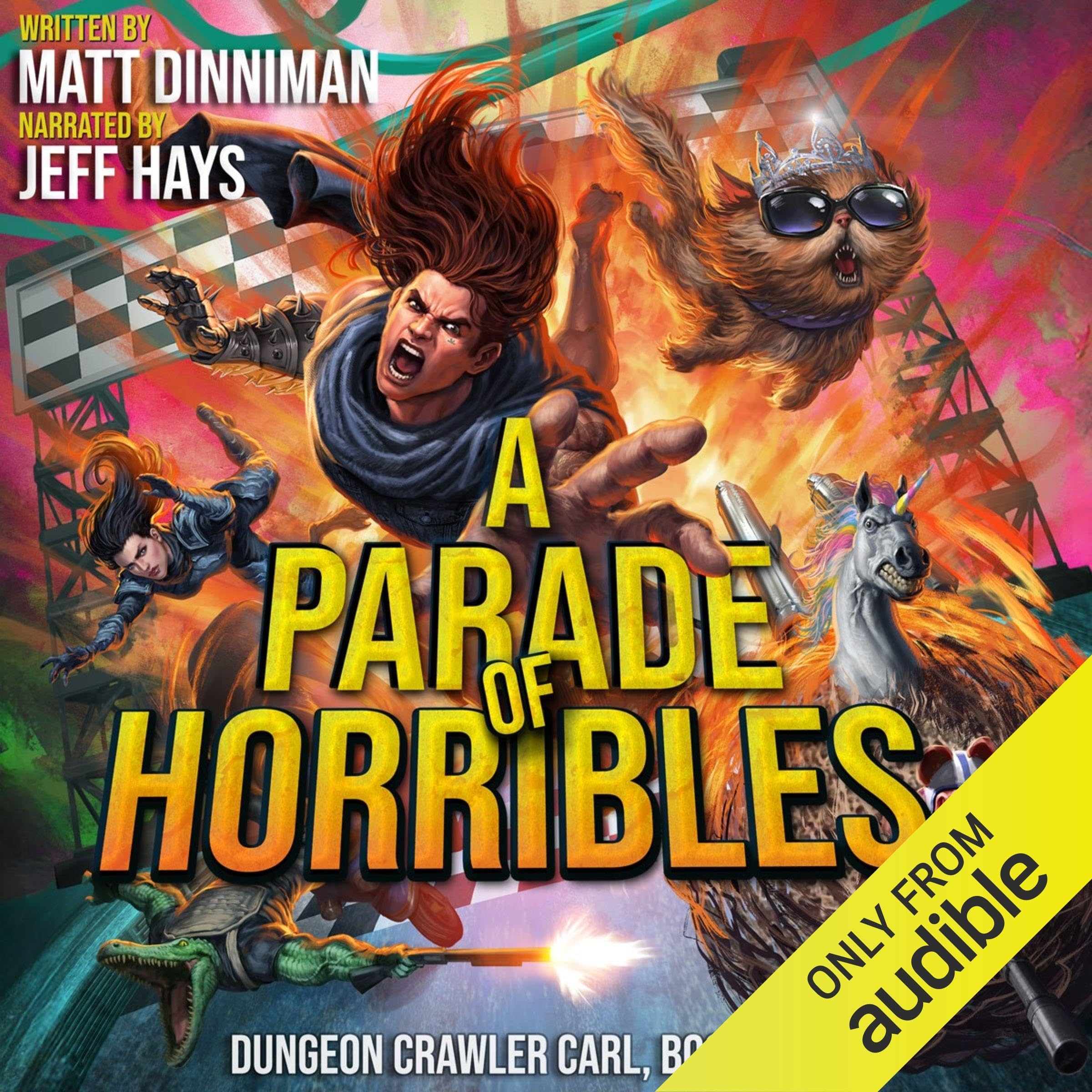
Matt Dinniman’s A Parade of Horribles is the eighth entry in the Dungeon Crawler Carl series, and it arrives with the weight of a sprawling, increasingly complex narrative. For those who have followed Carl and Princess Donut through the alien-run dungeon crawl, this book is another long, dense installment that continues the story rather than reinventing it. The series has always been a blend of dark humor, brutal action, and surprisingly thoughtful world-building, and this volume sticks to that formula.
In practice, this is a book you read when you’re already invested in the overarching plot. New readers should absolutely start with Book 1: Dungeon Crawler Carl, as this entry assumes familiarity with the characters, the rules of the dungeon, and the political machinations of the AI and the various factions. The story picks up immediately after the events of the previous book, with Carl and Donut navigating a new floor that is, as the title suggests, a parade of increasingly absurd and deadly challenges. The pacing is relentless; the book is almost entirely action and dialogue, with little downtime for reflection. This can be exhilarating but also exhausting, especially if you’re reading in long sessions.
Key features of this installment include the continued evolution of the dungeon’s AI, which remains one of the most entertaining and unpredictable elements of the series. The AI’s commentary and rule-bending antics provide much of the humor. The book also introduces new floor mechanics that force Carl and his party to adapt, such as environmental hazards and enemy types that require creative problem-solving rather than just brute force. The loot system, always a highlight, remains detailed and occasionally absurd, with items that have very specific, sometimes useless, applications. The writing is sharp and often funny, though the humor can veer into crudeness that might not appeal to everyone.
However, there are notable trade-offs. At over 600 pages, A Parade of Horribles feels long, and some sections drag as the action becomes repetitive. The book leans heavily on extended combat sequences that, while well-choreographed, can blur together. The character development, a strength of earlier books, takes a backseat here; Carl and Donut’s relationship, while still central, feels more static, with fewer new insights. The plot also introduces several new subplots and characters, but not all of them get satisfying resolution within this volume, which may frustrate readers looking for a more self-contained story.
Compared to other progression fantasy series like He Who Fights With Monsters or The Wandering Inn, Dungeon Crawler Carl is more focused on immediate, high-stakes action and less on slice-of-life or deep world-building. Where those series might spend chapters on character interactions or crafting, this book is almost entirely about survival and escalation. It’s a trade-off that works for some readers but might leave others wanting more variety. The series is also more overtly comedic than many of its peers, which can be a double-edged sword—the jokes land often, but they can also undercut moments that might otherwise carry more emotional weight.
Who is this book for? It’s best suited for existing fans of the series who are committed to the long haul and enjoy the specific tone and pacing that Dinniman has established. If you’ve enjoyed the previous seven books, you’ll likely find this one satisfying, even if it’s not the strongest entry. It’s also a good fit for readers who appreciate dark humor, inventive combat systems, and a plot that doesn’t take itself too seriously.
On the other hand, this book is not for newcomers or for readers who prefer more tightly plotted, standalone stories. If you’re looking for a book with extensive character growth or a slower, more reflective narrative, this probably isn’t it. The length and density can also be a barrier for those with limited reading time, as the book demands sustained attention to keep track of the many threads. Additionally, the crude humor and occasional gore might not suit readers who prefer a more restrained tone.
In terms of performance, the audiobook version, narrated by Jeff Hays, remains a highlight. Hays’ vocal range and energy add a lot to the experience, especially for the AI’s voice and the various character accents. The production quality is high, though the sheer length of the audio (over 20 hours) means it’s best consumed in chunks rather than all at once. The physical book and ebook are well-formatted, though the complex stat blocks and item descriptions can be a bit dense on the page.
Ultimately, A Parade of Horribles is a solid continuation that delivers what fans expect, but it doesn’t push the series forward in a major way. It’s a comfortable, if long, entry in a series that knows its audience. If you’re in the middle of the journey, this book will keep you entertained, but it’s unlikely to convert new readers or change anyone’s mind about the series’ strengths and weaknesses.